

You find a gorgeous amethyst bracelet for ₹199, the photos glow, the reviews look cheerful, and it arrives looking nothing like the listing. Most crystal buyers in India have had some version of this experience. Online shopping makes crystals accessible, but it also makes imitations easy to sell.
This guide explains how to tell real from fake crystals before and after you buy. It covers common lookalikes, red flags in listings, simple home checks, and the questions worth asking a seller. It also gives an honest caveat: no home test is perfect.
What “Fake” Actually Means in Crystals
The word covers several different things, and the distinction matters.
- Glass: Coloured glass sold as amethyst, citrine or “opalite”. It is often bubble-free, very uniform and unusually clear.
- Dyed stones: A real mineral coloured to look like something pricier. Dyed howlite sold as turquoise is the best-known case. Dyed agate also appears as “lapis” or “ruby”.
- Heat-treated stones: Much citrine on the market is heat-treated amethyst. This is a widely accepted trade practice, but it should be disclosed. Natural citrine is pale and comparatively rare.
- Reconstituted or pressed stones: Powder or chips bonded with resin, common with turquoise, lapis and sometimes malachite.
- Plastic or resin: Light, warm to the touch and cheap, sometimes passed off as amber or moonstone.
Treated is not the same as fake. A bead that is honestly described as “dyed agate” is fine. A bead sold as “natural lapis lazuli” that is actually dyed is not.
Red Flags in Online Listings
Start with the listing itself, because most problems are visible before you pay.
1. Prices that do not add up. Real lapis lazuli, turquoise and good labradorite cost real money per bead. A full bracelet at a very low price is probably dyed, pressed or glass. Prices of ₹499 to ₹1,599 are a more realistic range for genuine bead bracelets, though price alone never proves authenticity.
2. Vague names. “Crystal stone”, “healing quartz” or “Sulemani look” tell you nothing. A trustworthy listing names the mineral and notes any treatment.
3. Impossibly perfect colour. Natural stones vary. Electric blue “turquoise” or neon “citrine” in identical beads suggests dye or heat.
4. Stock or heavily filtered photos. Check whether the same images appear on several unrelated sites. Ask for a photo or short video in daylight.
5. No return policy or contact details. A genuine seller expects questions.
6. Unusual stones at bargain rates. Rare varieties, such as natural citrine or high-grade moonstone with blue flash, are seldom cheap.
Stone-by-Stone Lookalikes
| Stone | Common imitation | What to look for |
| Amethyst | Purple glass | Natural colour banding, tiny inclusions, uneven shade |
| Citrine | Heat-treated amethyst or yellow glass | Natural citrine is pale, smoky yellow; deep orange often means heated |
| Turquoise | Dyed howlite, plastic | Howlite shows grey-white veining and dye pooling around drill holes |
| Lapis lazuli | Dyed jasper or glass | Real lapis has irregular gold-coloured pyrite flecks and white calcite patches |
| Labradorite | Glass with painted flash | Real flash shifts with angle and appears only in some directions |
| Moonstone | Glass or “opalite” | Real moonstone shows soft blue adularescence inside, not a uniform glow |
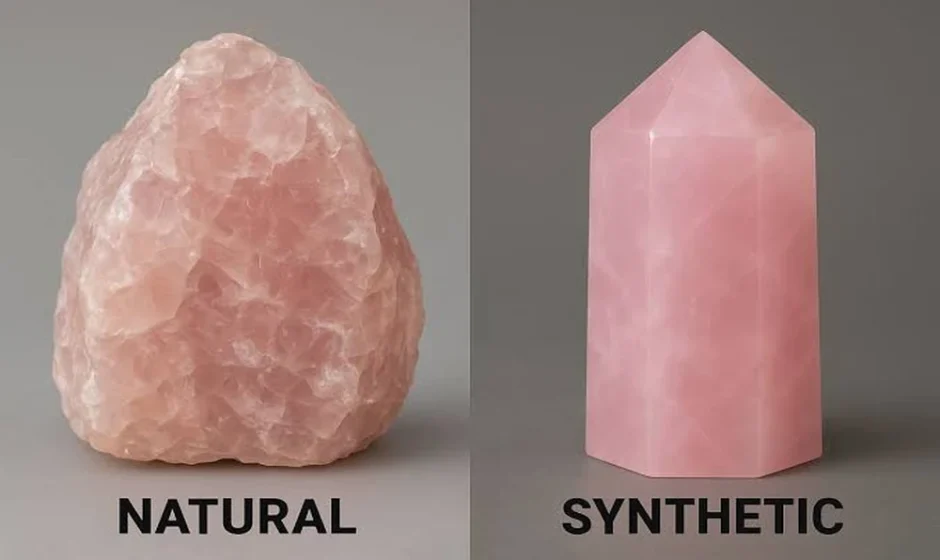
| Rose quartz | Dyed or glass | Natural pink is pale and slightly cloudy |
| Black tourmaline | Black glass or resin | Real stones often show faint vertical striations on raw pieces |
“Opalite” deserves a special mention. It is man-made glass, not a natural stone, though it is often sold as one. A seller who calls it “natural opalite” is misleading you.
Simple Checks When Your Stone Arrives
None of these is conclusive alone. Use several together.
- Temperature: Genuine stone feels cool and takes a while to warm in your hand. Plastic warms quickly.
- Weight: Natural stone usually feels heavier than resin or plastic of the same size.
- Inclusions: Look under bright light with a magnifying glass or your phone camera. Tiny cracks, wisps or mineral specks are normal in natural stone. Round, perfectly spherical bubbles suggest glass.
- Colour at the drill holes: Dye often collects around the holes or in cracks. Look there first.
- Scratch test: Quartz, including amethyst, citrine and rose quartz, scratches ordinary glass. Test carefully on an inconspicuous spot, never on a bead you plan to wear, and remember that glass can be hard too.
- Acetone or alcohol rub: On a hidden spot, a cotton bud with a little nail-polish remover may lift colour from dyed stone. This can damage treated or coated stones, so go gently.
- Light test: Hold amethyst against a torch. Natural stones show uneven colour, while glass is uniform.
For anything expensive, such as a stone you will wear as a Vedic remedy like Gomed (hessonite), a lab report from a recognised gemmological laboratory is far more reliable than any home test. Many astrologers recommend this, and it is sensible advice.
Questions to Ask the Seller
A good seller can answer these plainly:
- Which exact mineral is this, and is it dyed, heated or stabilised?
- Where is it sourced, even in general terms such as Brazil or Rajasthan?
- Can you share a daylight photo or video of the actual piece?
- What is your return or exchange policy if it does not match the description?
- Does the bracelet have any elastic or thread details, and how many beads and what size?
Hesitation, evasive answers or pressure to buy quickly are signals to walk away.
Does Authenticity Matter for Spiritual Use?
Crystal work rests on tradition and personal belief, not laboratory proof. Even so, most wearers want the stone they chose for its associations, whether amethyst for calm or tiger eye for confidence, and not coloured glass. Honest labelling respects that intention. A dyed stone can still be lovely if you know what you are buying.
Caring for Genuine Stones
Once you have a real piece, keep it that way. Avoid soaking porous or dyed stones such as turquoise and lapis in water. Remove bracelets before bathing, cooking or applying perfume, and wipe with a soft dry cloth. Many Indian wearers cleanse stones with sage smoke, moonlight or on Shivratri, which is a gentler option for delicate beads.
FAQs
Can I identify a fake crystal from a photo alone?
Not reliably. Photos can reveal red flags such as uniform colour or vague naming, but you will need the piece in hand, or a lab report, for certainty.
Is heat-treated citrine fake?
It is real quartz, but not natural citrine. A good seller will say so.
Does a certificate guarantee authenticity?
Only if it comes from a reputed gemmological laboratory and matches your stone. Generic seller-issued cards prove very little.
Is it safe to scratch-test my bracelet?
Only on a hidden spot, and with care. Avoid it on soft or valuable stones.
Final Thoughts
Spotting a genuine crystal online comes down to a few habits: read names carefully, treat unrealistic prices with suspicion, look closely at inclusions and dye marks, and buy from sellers who answer questions openly. No single test is foolproof, so combine them.
If you would like help choosing a stone for your needs, you can explore Ankastra’s bracelet collections or use the free crystal guidance to ask questions before you decide.